Store health dashboard
Catalog scores, attention summaries, and explicit analysis coverage help merchants decide where to focus.
Featured engineering project
Full-Stack Shopify Store Health Application
A merchant-facing Shopify application that turns catalog health analysis into practical, merchant-controlled SEO and accessibility fixes inside Shopify Admin.
Functional Development Build
View Source Code (opens in a new tab)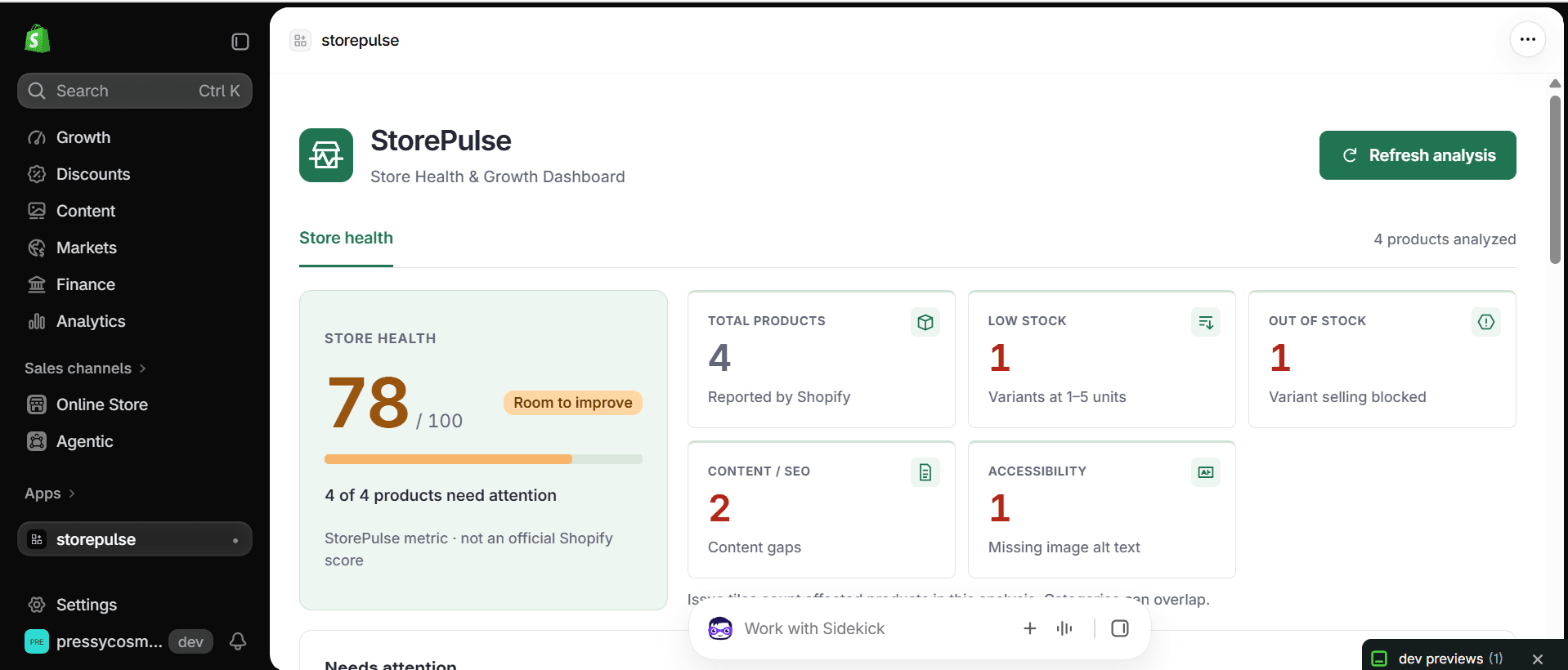
01 / The problem
Incomplete descriptions, missing custom SEO metadata, image accessibility gaps, and inventory risks are difficult to prioritize as a product catalog grows. Merchants need one actionable view rather than repeated manual checks.
02 / The solution
StorePulse retrieves real Shopify product data, calculates transparent health scores, and presents product-level evidence. Merchants can save selected SEO or alt-text edits through authenticated API operations, then review analysis recalculated from fresh Shopify data.
03 / Key features
Catalog scores, attention summaries, and explicit analysis coverage help merchants decide where to focus.
Transparent rules evaluate descriptions, imagery, alt-text presence, inventory readiness, and custom SEO completeness.
Merchants explicitly save custom SEO titles and descriptions through authenticated GraphQL mutations, with validation and stale-edit checks.
Product evidence identifies missing alt text and provides an editor for individual image files, including a shared-file disclosure.
Verified events record shop-scoped activity metadata with deduplication and protection against out-of-order timestamps.
Product search, issue filtering, paginated lists, detailed evidence, and prioritized recommendations connect diagnosis to action.
04 / Technical architecture
The embedded interface uses React Router loaders and server actions. Catalog analysis, merchant writes, and event receipts have distinct responsibilities.
Webhooks record activity metadata; they do not rescan the catalog or refresh an open dashboard. Navigation and manual refresh retrieve current Shopify data.
05 / Engineering highlights
Shopify authentication supplies the shop and API client. Tokens stay server-side; posted shop identifiers do not grant authority.
Paginated product, image, and variant records feed one deterministic scoring engine shared by dashboard and detail pages.
Only explicit saves update SEO or image alt text. Ownership, input, stale edits, and duplicate submissions are checked before mutations.
Prisma and SQLite persist sessions and minimal webhook metadata. Transactions deduplicate deliveries and isolate records by shop.
A fresh Shopify read verifies each save before analysis revalidation. Unconfirmed rereads are clearly reported instead of assuming success.
Tests cover scoring, pagination, API failures, remediation, webhook authentication, tenant isolation, and persistence behavior using mocked APIs.
Scans currently analyze up to 250 products, with full nested media and variant pagination. Scores are completeness heuristics, with coverage disclosed; they are not SEO rankings or accessibility certifications.
06 / Development status
StorePulse has been implemented and tested against a Shopify development store. Production deployment and Shopify App Store publication are planned next steps; public merchant installation is not yet available.
Explore the source code, scoring rules, remediation design, and synchronization documentation.